

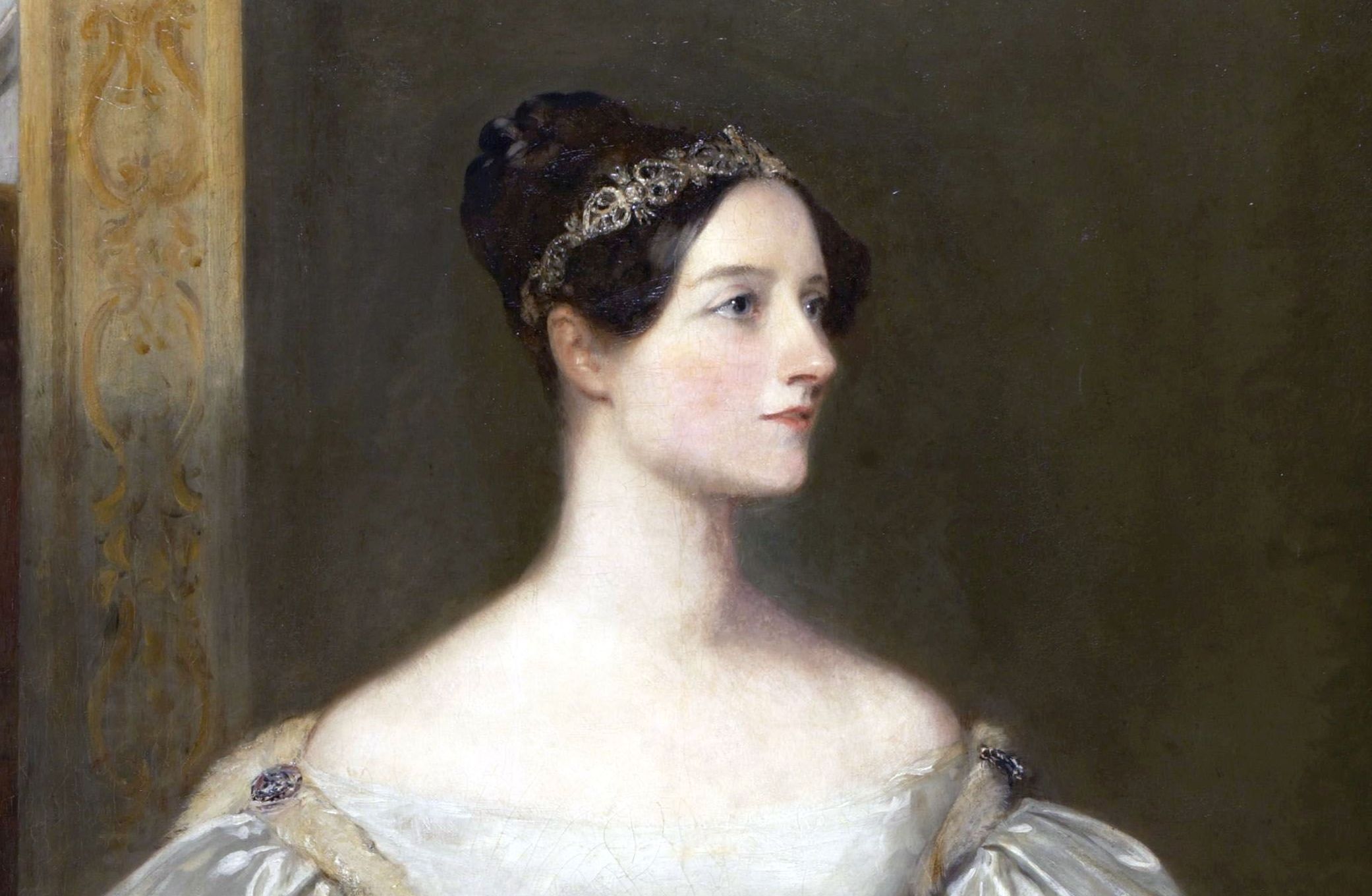
Augusta Ada King (nee Byron), Countess of Lovelace (1815-1852)
Mathematician and Computer Programmer. The City’s markets, payment systems and financial services run on software founded on the idea, first set out in her Notes, that a machine can be given a sequence of instructions to carry out any process expressible in symbols, not just arithmetic.
City of London Connections
Lovelace was a Londoner throughout her life, born in Piccadilly, daughter of the poet Lord Byron and Annabella Milbanke, and living from 1837 to 1846 at 12 St James’s Square, where she wrote the Notes (see below). Her founding contribution to computing was printed and published in the City. Her translation and Notes on the Analytical Engine appeared in 1843 in Scientific Memoirs, edited and printed by Richard Taylor at his press in Red Lion Court, Fleet Street – the firm that also printed the Royal Society’s Philosophical Transactions and later grew into the scientific publisher Taylor & Francis. The first published computer program came off a City press.
Contribution to Engineering
In 1833, aged 17, Lovelace was introduced to Charles Babbage, probably by her mentor the scientist Mary Somerville, and saw a working demonstration section of his Difference Engine. She grasped the machine’s principles at once and remained his close correspondent for the rest of her life.
In 1842 the Italian engineer Luigi Menabrea published, in French, an account of Babbage’s design for the Analytical Engine: a mechanical, general-purpose computer with a separate store (memory) and mill (processor), to be programmed with punched cards adapted from the Jacquard loom. Lovelace translated it and, working closely with Babbage, added seven Notes, labelled A to G, around three times the length of the original paper. They were published in 1843 and signed “A.A.L.”
The Notes are the clearest account written in the nineteenth century of what a programmable computer is. They explain how the Analytical Engine differs from a calculator, describe how operations and variables are coded on cards, and show how a sequence of instructions can be repeated in loops. Note G sets out, step by step, a table of operations for the Engine to compute the Bernoulli numbers. Babbage had sketched shorter programs earlier, but hers was the most elaborate and complete, and the first to be published; it is widely regarded as the first computer program.
Lovelace also saw further than Babbage himself. She recognised that the Engine could manipulate any symbols whose relationships could be expressed formally, not only numbers, and suggested it might one day compose music. In her own words, it would weave “algebraical patterns just as the Jacquard-loom weaves flowers and leaves”. This is the conceptual leap from calculating machine to general-purpose computer. She was equally clear about its limits, arguing that the Engine could do only what it was instructed to do; Alan Turing answered this directly as “Lady Lovelace’s Objection” in his 1950 paper on machine intelligence.
The Analytical Engine was never completed, and Lovelace died in 1852, aged 36. Her achievement was the engineering of instructions rather than of hardware: the first systematic account of how to make a machine do useful work by programming it, nearly a century before electronic computers existed to run the code.
Legacy
Every program written today is a descendant of the method set out in Note G. In 1980 the US Department of Defense named its new programming language Ada in her honour, with the military standard number MIL-STD-1815 marking her birth year; Ada is still used in safety-critical systems in aviation, rail and defence.
Lovelace has become the leading symbol of women in science, technology, engineering and mathematics. Ada Lovelace Day, held on the second Tuesday of October since 2009, celebrates women in STEM worldwide. Her name is carried by the BCS Lovelace Medal, the Ada Lovelace Institute for research on data and AI, Ada, the National College for Digital Skills, and university buildings across the UK. At a time when women remain under-represented in engineering and computing, she shows that the profession’s foundations were laid by a woman who was denied the formal education her male contemporaries took for granted.
Evidence of Esteem, Fame and Inspiration
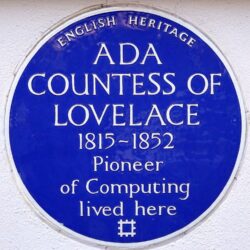
An English Heritage blue plaque was erected in 1992 at 12 St James’s Square, London (see right). A bronze statue by Etienne and Mary Millner was unveiled on Horseferry Road, Westminster, in 2022. She was on the Bank of England’s shortlist of scientists for the new £50 note.
Her bicentenary in 2015 was marked by exhibitions at the Science Museum and the Bodleian Library, and a programming language, a national college, an institute, an international day and a major BCS medal all bear her name.
References and Further Information
- Analytical Engine trial piece and Difference Engine No. 2, on display at the Science Museum, London
- Lovelace Byron Papers, Bodleian Library, Oxford
- Translation and Notes, Scientific Memoirs III (1843), full text: yorku.ca
- Ada Lovelace Day: findingada.com
- Benjamin Woolley: The Bride of Science (1999)
- James Essinger: A Female Genius (2014)
- Sydney Padua: The Thrilling Adventures of Lovelace and Babbage (graphic novel 2015)
- Betty Alexandra Toole: (Augusta) Ada Byron [married name (Augusta) Ada King, countess of Lovelace]: (1815–1852), mathematician and computer pioneer Oxford Dictionary of National Biography entry (free to UK Library Card holders) (2017)
Contribution to Sustainable Development Goals
As the inspiration for a worldwide movement to bring women into science and engineering, Lovelace contributes directly to Goal 5: Gender Equality and Goal 4: Quality Education. The software-driven computing she first described underpins today’s digital economy, contributing directly and indirectly to Goal 8: Decent Work and Economic Growth; Goal 9: Industry, Innovation and Infrastructure; and Goal 10: Reduced Inequalities.

Banner image cropped from portrait of Ada Lovelace by Margaret Sarah Carpenter, Public domain, via Wikimedia Commons
Text adapted from a citation prepared by Tola Sargeant, CEO, Archives of IT.
Related items


David Kirkaldy (1820-1897)


Sir Henry Bessemer (1813-1898)


Sir Joseph Bazalgette (1819-1891)

